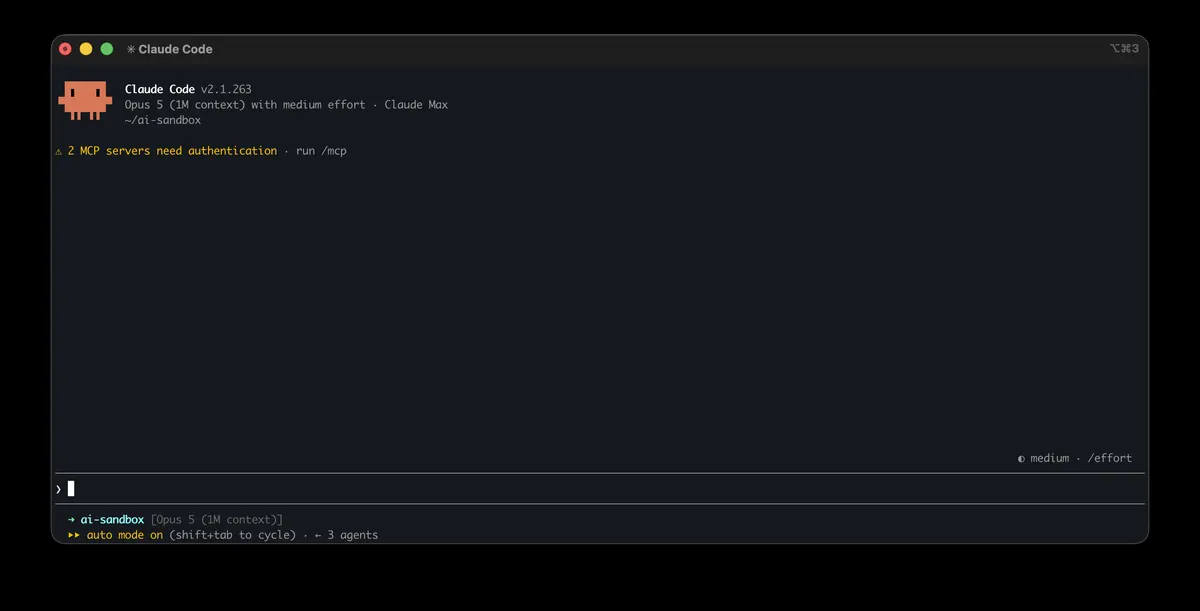
Claude Code
The most mature subagent system; included in any paid Claude plan.
Price and access
- Free?
- No, paid plans only
- Price
- Max $100 / Ultra $200 per seat
- From Russia
- Russia is not on Anthropic's supported-regions list: the service is unavailable from Russia.
- Models
- Opus 5.5 · Fable 5.1 · Sonnet 5.5
- Licence
- closed-source
- Our benchmark
- Models in our benchmark →
Unavailable from Russia. Similar tools that work: Kimi Code CLI, ZCode, DeepSeek Harness.
What changed in price and access
- Anthropic renamed its plans: Max 5x became Max at $100 a month and Max 20x became Ultra at $200; verified Ultra accounts no longer have the five-hour limit ↗
- Claude Haiku 5.5: $0.10 and $0.50 per million tokens for prompts up to 100k – about 75% cheaper to run than Haiku 4.5 per Anthropic; Sonnet 5.5 cache reads halved ↗
- BugHunt: Sonnet 5.5 at max effort fixed the most bugs – 55.5 of 105 on average against 41.7 for Opus 5.5 – but a run cost about $135 against $59 and took almost four hours against 67 minutes: for every fix it writes a test and confirms the test fails with the fix reverted ↗
- Claude Opus 5.5 released: $4 per million input and $20 per million output tokens – 20% cheaper than Opus 5, with cache reads 60% cheaper ↗
- Redesigned Projects in Claude Code entered beta for select Pro and Max subscribers on cloud sessions; others can join the waitlist ↗
Changes for this tool in total: 14. The full feed for all agents →
What it gives a manager
- Cloud schedules: a morning digest of open PRs and failed builds every day, without your laptop being on.
- Code Review on Team and Enterprise: the agent reviews every new PR, averaging $15–25 per review, with a monthly org-wide spend cap.
- Team analytics: accepted lines, agent-assisted PRs and a user leaderboard; on Enterprise, per-person spend via an API.
- Managed settings: admins block tools, cap model effort and set spend limits per group, and developers cannot override them.
Weak points
- The $20 Pro plan now defaults to Opus 5.5, but Fable 5.1 comes only with Max ($100) and Ultra ($200), under a separate weekly limit.
- Splitting a 5,040-line file took Opus 5 36 minutes, almost 5x longer than Codex on the same prompt.
- Usage is shared with the Claude chat app: about 45 prompts per 5 hours on Pro by community estimate, Anthropic publishes no numbers.
- Jordan Urbs cancelled the $200 Max plan over vendor lock-in: two of his 700M-token days would have cost about $1,800 at API prices.
How to check this agent’s work
- Read the plan before it runs: in plan mode the agent lists the files it intends to change.
- Get a second opinion: a separate session or a reviewer subagent with a clean context reads the finished diff.
- Ask for the test output, not a summary: "tests passed" without a log is not a check.
Picking an agent takes an evening. After that the question is not the price but whether you can trust what it did.
You’re on the list
We will write when enrolment opens. Meanwhile, here is what the course covers.
The short course programmeWhat the course covers: programme and price
Strengths
- In Tech With Tim's tests Opus 5 went deeper: 27 tests for a habit tracker and its own proof tool when splitting a 5,040-line file.
- Included in every paid Claude plan; runs in the terminal, VS Code, JetBrains, the web, a mobile app, Slack and GitHub Actions.
- CLAUDE.md memory, subagents, hooks, MCP, background agents and cloud-scheduled routines, per Anthropic's docs.
- The Claude Code team says it now does 70 to 80% of its work through the Slack agent and daily routines that triage feedback.
Alternatives
 Kilo Code
 ZCode
 Kimi Code CLI
Who it is for
- Engineer who knows the repo, branches, and terminal
- Team where Anthropic is available and wants one tool for everyone
- Manager who hands the agent tasks from Slack or on a schedule and reads the finished reports
Example from a review: Split a 5,040-line file without breaking anything
Tech With Tim gave Codex and Claude Code the same prompt: split a 5,040-line file from the Textual library and keep everything working. Opus 5 got it done but took 36 minutes, almost 5x longer than Codex, because it also wrote a proof tool showing that behaviour had not changed. Haiku did not finish: it created the new files but never removed the original. The reviewer's verdict is that you pay for that depth in time and subscription quota.
Source: Tech With Tim, "Codex vs Claude – an Honest Comparison"
Reviews (8)
The video authors’ opinions, not our conclusions.
- Codex vs Claude – an Honest Comparison · Tech With Tim, 27 August 2026The reviewer's view: pick Claude Code for depth, since Opus 5 did more than asked on all five tasks, but expect it to be several times slower and heavier on quota.
- How the Claude Code team uses Claude Code · Claude, 2 September 2026Anthropic's own engineers describe moving from watching every tool call to handing goals to a Slack agent and cloud routines; this is the vendor talking about itself.
- Why I Cancelled My Claude Code Subscription · Jordan Urbs, 6 September 2026The author thinks the $200 Max plan is too good a deal to last and moved to OpenCode with open-weight models so his workflow no longer depends on Anthropic.
- Is Pi the Best Coding Agent? Pi vs OpenCode vs Claude Code · pookie, 24 May 2026The author left Claude Code for the minimal Pi, citing a 14,000-token system prompt and subagents whose work you cannot see.
- How auto mode works with Claude Code · Claude, 4 August 2026The vendor explains auto mode: a separate classifier judges risky actions, deny/ask/allow rules run before it, and admins set managed settings developers cannot remove.
- How Ramp engineers work with AI agents at every step · Claude, 6 August 2026Ramp (with the vendor): a fixed set of hard tasks rerun on every model, read-only keys for agents, no per-person budgets; the claimed CI drop from 18 to 6 minutes is unverified.
- DoorDash gave every employee Claude Code · Claude, 7 July 2026DoorDash (with the vendor): every manager had to ship production code with an agent, a fast procurement path, written write-ups of failures; the bottleneck moved to product reviews.
- How Spotify runs agents across 20M+ lines of code · Claude, 29 June 2026Spotify (with the vendor): an LLM judge lifted automated PR success from 20 to 30 percent to 80, then was removed; auto-merge forced investment in test automation.
Facts with sources
- Pro at $20 is enough to try it out: on a real task the limits run out within a couple of hours, so plan the team budget from Max. Source (in Russian)
- The subscription gives you only Claude: you can't switch models within it. Source (in Russian)
- On July 21 the system prompt was cut by about 80%: newer models handle context better than a list of rules. Source (in Russian)
- Anthropic asks for identity verification with a document and a selfie; corporate signs of use from Russia lead to loss of access. Source (in Russian)
- Since October 30 the Max 20x plan is called Ultra at the same $200: verified accounts have no five-hour limit, only the weekly one. Source
- Code Review on Team and Enterprise is billed separately from seats: $15–25 per review on average, with a spend cap in organization settings. Source
- Cloud sessions and scheduled tasks, Code Review and Remote Control need a claude.ai sign-in; they do not work with an API key or a cloud provider alone. Source