Chat Z.AI (GLM-5) in 2026: The Chinese Model That Pretends to Be Claude
AI models in this article
On February 6, 2026, an anonymous model called “Pony Alpha” showed up on OpenRouter – free, with no word on who built it. The AI community immediately started trying to work out who did. Its coding skills came close to Claude Opus 4.5. Ask it “who are you?” and it answered “I am GLM.” But ask it to build a web page describing itself, and it wrote: “I am Claude, created by Anthropic.”
That happened every single time. And it frames everything you need to know about GLM-5 before we get to benchmarks and pricing.
Try It Yourself: GLM-5.3 vs GigaChat 3.5 vs Claude Sonnet 5
Before the history, the benchmarks and the pricing – run a prompt right here and compare three models on the same task: GLM-5.3 (Z.ai), GigaChat 3.5 Ultra (Sber, Russia’s largest bank) and Claude Sonnet 5 (Anthropic). Three very different bets: the cheap Chinese challenger, a Russian model built around its home market, and the Western premium flagship.
Example 1. A tactful letter to a supplier
You
You are the head of procurement at a mid-size US retail chain. Write a letter (up to 180 words) to a packaging supplier you have worked with for 6 years, explaining that after a recent tender you are temporarily moving to another vendor because of price. The letter should: preserve the relationship, state the reason honestly without corporate jargon, leave the door open for future work together, and not offend the partner. Tone – respectful, human, no "please be advised" boilerplate.
The task tests tone, business etiquette and plain-English diplomacy at once. GigaChat is trained first and foremost for Russian, so on an English letter it tends toward a stiffer register, Claude usually balances empathy and clarity, and GLM-5.3 is the interesting one: how close does a Chinese model get to natural Western business correspondence? Further down there is a second prompt, an analytical one, where the strengths line up differently.
What GLM-5 Is and Who Is Behind It
 GLM 5.1Follows clear tasks
score 5.6/10 rank 57 of 74 $0.016 per task no VPN
Tested in the mysummit.school benchmark: May 2026About the model →Compare →
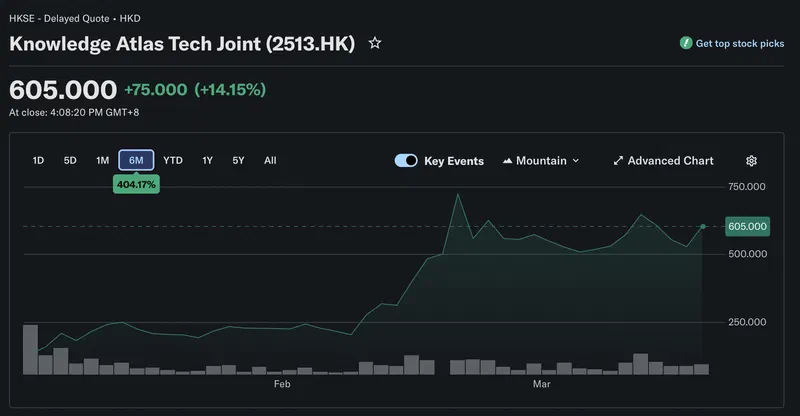
Zhipu AI grew out of Tsinghua University. Founded in 2019, it rebranded as Z.ai by 2025 and listed on the Hong Kong Stock Exchange in January 2026. The IPO went well: in the three days after the official GLM-5 announcement, the stock rose 60%.
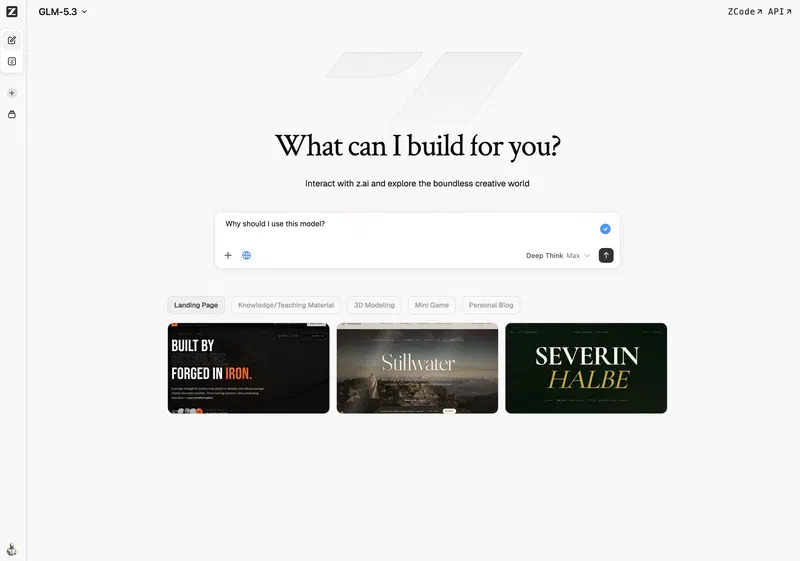
GLM-5 launched on February 11, 2026, and immediately claimed the title of the strongest open model in the world. Three things matter for a manager:
- Open and free – the code is available under the MIT license; any company can download the model and run it on its own servers
- Long context – a single request can “read” up to ~400 pages of text, handy for long documents, reports and contracts
- Trained on Chinese chips – entirely on Huawei hardware, without a single NVIDIA component
Under US export controls, that last point reads as a political statement: China can build competitive AI models without access to Western chips. For a business, it means the vendor does not depend on Western sanctions policy – unlike OpenAI or Anthropic.
GLM-5.2: A New Generation (June 13, 2026)
GLM 5.2Follows clear tasks
score 5.8/10 rank 50 of 74 $0.012 per task no VPN
Tested in the mysummit.school benchmark: July 2026About the model →Compare →
While GLM-5 was still being reviewed, Z.ai shipped the next version. GLM-5.2 came out on June 13, 2026, and it is built for coding.
- 1M-token context (up from 200K in the previous version) – the model holds a whole repository in memory without losing the thread.
- A 744B-parameter MoE architecture, with only 40B active per token – hence the mix of power and a moderate price.
- Open weights under the MIT license and two reasoning levels, High and Max (Max is meant for complex multi-step tasks).
- Available through GLM Coding Plan subscriptions (from ~$18/month), a standalone API and a web chat.
True to the whole GLM story, Z.ai published no benchmarks at launch. In an industry where models usually ship with a ready-made table of wins, that is unusual. Independent tests appeared a few days later, and the model proved strong at code: 62.1% on SWE-bench Pro against 58.6% for GPT-5.5. It took second place among coding models on the blind Code Arena leaderboard and came close to Claude Opus 4.8 on Terminal-Bench – at a noticeably lower price than GPT-5.5.
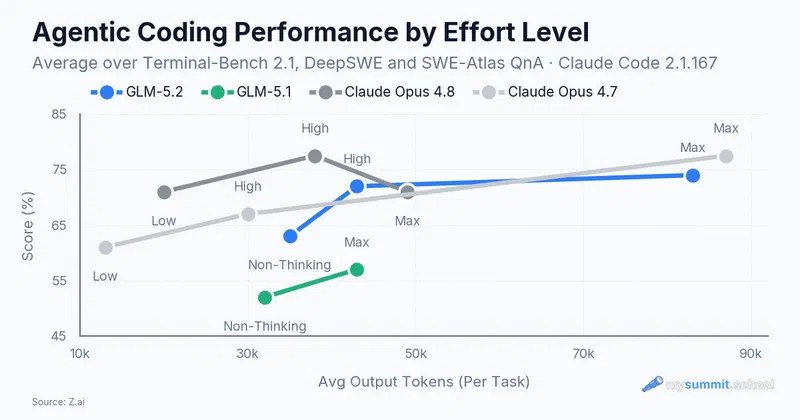
That strength costs tokens. On Z.ai’s own agentic-coding chart, GLM-5.2 at maximum reasoning nearly catches Opus 4.8, but spends about twice as many output tokens and still trails slightly at the peak. Cheaper per token – but it burns more of them.
Planning is where GLM-5.2 shines. In our tests it settled open questions itself and explained its choices instead of leaving them to the developer. One example: the model not only cached a lookup for a flag that did not exist yet, it also spotted the non-obvious trap – that cache has to be cleared if the flag is created later. A plan is worth as much as the number of questions it resolves before work begins, and by that measure GLM-5.2 is strong.
For managers: GLM-5.2 is first of all a tool for development and engineering planning. On coding tasks and technical design it competes with the flagships at a noticeably lower price. How it behaves on business tasks is a separate story – see below.
GLM-5.3: Gains Without a New Base Model (August 14, 2026)
GLM-5.3 is not in our benchmark yet – the figures below come from the vendor and independent platforms.
The most important thing about this release is what it lacks. Z.ai did not train a new base model: GLM-5.3 sits on exactly the same base as GLM-5.2, and every gain came from post-training – data, labeling, reinforcement learning methods.
According to Z.ai, the most telling jump is on Terminal-Bench 3.0, where the model gets a terminal and has to finish the task: from 4.6 to 28.3 points. A sixfold gain on an unchanged base model. On DeepSWE v1.1 the score went from 46.2 to 66.9. On CyberGym, which tests defense against cyberattacks, from 77.2% to 84.5%.
The practical lesson for a manager: a large share of a modern model’s usefulness is created after pre-training. That kind of tuning can be redone in months, while a new base model takes years. When a vendor promises a “new model”, ask what exactly is new: the architecture and scale, or tuning on top of the old base.
Prices did not change: $1.40 per million input tokens and $4.40 per million output tokens. Context is 1M tokens, the maximum response is 128K, and reasoning mode is always on – you cannot switch it off. That means part of your budget goes to thinking tokens you never asked for – exactly the trait that made GLM-5.2 spend twice as many output tokens as Opus 4.8 on comparable tasks.
The model is text-only. It cannot read images, and that turned into a story of its own.
GLM-5.3’s open weights were not published at release – Z.ai held them back for a post-release safety review. The release tagline: “Built to Code. Ready for Cyber Defense”.
Fourteen Hundred Requests for Vision
On June 29, 2026, Zhipu founder Tang Jie asked the community what the next GLM was missing. More than 1,400 replies came in, and the most common request was vision. Developers wanted the model to read screenshots, PDFs, UI mockups and error messages on its own. The working workaround looked like this: Qwen-VL parses the image and passes the text to GLM-5.2. An extra link in the chain, extra latency – and paying for two requests instead of one.
Z.ai executive Li Xuan publicly acknowledged that the word “vision” had flooded the comments. No commitment followed.
A month and a half later GLM-5.3 shipped – without vision. Vision arrived twelve days after that, in a different model.
The case is worth noting precisely because it is typical of the industry. A vendor can collect as much feedback as it likes; it is under no obligation to act on it. Plan around what has already shipped and is available through the API.
GLM-5.3-Flash (August 26, 2026)
This is Z.ai’s biggest news of the summer, and it is not in our benchmark yet either. Six days before the announcement, the same model was running for free on OpenRouter as stealth/ox-alpha, with no author listed – more on that episode below, in the Pony Alpha section.
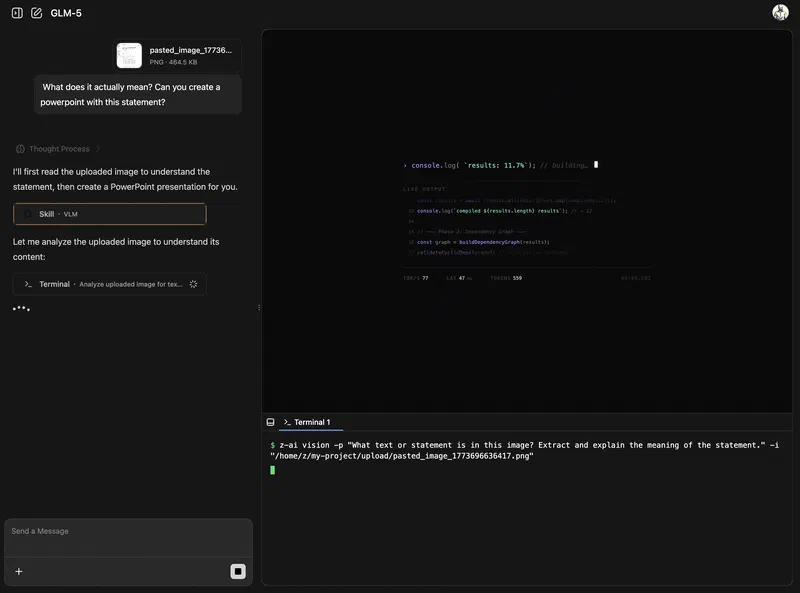
GLM-5.3-Flash is the first natively multimodal model in the GLM-5 family. It accepts text, images, video and files as input. No second model is needed to parse a picture anymore.
Architecturally it is a 320B-parameter MoE with 18B active per token: each token is routed to 8 experts out of 288. Attention is hybrid – linear KDA layers alternate with sparse MLA layers without positional encodings. The IndexPool mechanism shrinks the KV cache 4.4x relative to GLM-5.3, and mHC roughly halves the number of activated parameters relative to GLM-4.5. Context is 1M tokens.
These details matter for one reason: they are what let the price sit ten times below the flagship at comparable quality. The savings come from the engineering of serving a request, while the depth and quality of reasoning barely suffered.
Pricing: $0.15 per million input tokens, $0.03 for cached input and $0.50 per million output tokens. Until September 9, 2026, there is a 50% discount: $0.075 input and $0.25 output. In GLM Coding Plan subscriptions, Flash comes with three times the GLM-5.3 quota.
Z.ai’s own numbers: Terminal-Bench 2.1 – 84.3 points against 85.0 for Claude Opus 4.8. DeepSWE v1.1 – 63.4 against 46.2 for GLM-5.2. AutomationBench – 48.8 against 26.2. These are vendor figures and you should re-check them on your own tasks, but the gap is too wide to write off as marketing.
GLM-5.3-Flash weights are on Hugging Face under MIT – no revenue threshold and no restrictions on use. That is the most permissive license of any model in this review. For comparison: Qwen3.8-Max is open, but above $50M in revenue it requires a separate agreement with Alibaba; Kimi K3’s threshold is $20M. In 2026, “open weights” spans everything from MIT to a contract with your lawyers, and a manager needs to know which end they are on.
Running it yourself takes about 306 GiB of weights in FP8 and NVIDIA Hopper-class GPUs or newer. That is a project for a mid-size or large organization with its own cluster – not a weekend job. Before release, the model was also tested on domestically made Chinese chips.
What Independent Platforms Show
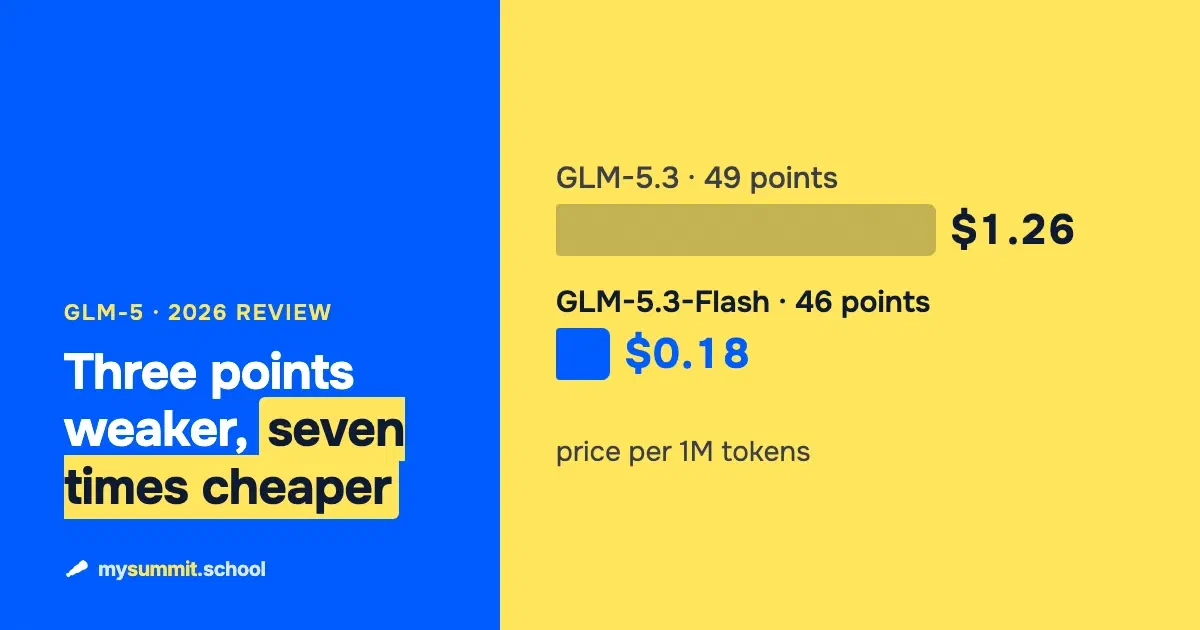
Artificial Analysis tests every model under the same conditions, which makes its data more useful than launch tables. GLM-5.3 at maximum reasoning scores 49 on the Intelligence Index. Blended price – $1.26 per million tokens, speed – 87 output tokens per second. GLM-5.3-Flash scores 46 at $0.18.
Three points of measured intelligence for a sevenfold price difference.
Check the scale, though. Artificial Analysis publishes its index in versions and rescales it between them, so the 60 points in Z.ai’s August release (index version 4.1.1) and the 49 points on the current leaderboard are different rulers. You can only compare within one snapshot – which, incidentally, is a general rule for reading any leaderboard: AI rankings regularly re-score models.
There are no GLM models in the LMArena top ten right now. That leaderboard has its own quirk: the confidence intervals of the top nine text positions overlap, which is a statistical tie. First place there is a difference within the margin of error.
“Cheap model beats expensive one” is not unique to Z.ai these days. On the same Artificial Analysis, Gemini 3.8 Flash costs $0.74 per million blended tokens, delivers 334 tokens per second and beats pricier models from Google’s own lineup. The “flagship is always better” reflex fires less and less often in 2026 – at both Google and Z.ai, the top model now costs several times more than it adds.
The Pony Alpha Story: An Investigation That Happened Twice
“Pony” is a nod to the Year of the Horse in the Chinese calendar. On February 11, Zhipu officially confirmed that Pony Alpha was GLM-5. The company’s stock rose 60% in three days.
The company never officially explained what actually happened. Zhipu did not comment on the identity confusion.
It is not an isolated case. In December 2025, MIT researchers found that GLM-series models identified themselves as Claude roughly 50% of the time under non-standard prompting. DeepSeek V3 had a similar quirk – with certain prompts it called itself ChatGPT or GPT-4. OpenAI responded by openly accusing DeepSeek of distilling its models and updated its terms of use. Anthropic, Mistral and xAI added similar anti-distillation clauses to theirs.
Distillation – training a smaller model on the outputs of a larger one – is, by all appearances, an open secret of the industry. There is no way to confirm it was used in GLM-5: we have no technical audit. No way to rule it out either: the behavioral patterns are too specific.
Six months later Z.ai pulled the same move again. On August 20, 2026, stealth/ox-alpha appeared on OpenRouter: free, with a million-token context, accepting text, images and video. No one was named as its maker.
People set out to identify the author from the infrastructure. Stack traces, error codes and tokenizer fingerprints produced 30 matches out of 30 with GLM-5.3 – at least that is how it looked in community reports. It did not produce consensus. TechCrunch described a community arguing with its own conclusions: AI analyst Andrew Curran noted that early versions pointed to Z.ai, but “by morning, people seem less sure of anything.” One outlet switched to the theory that this was an unreleased Microsoft MAI model. Reddit split between “this can’t be a Chinese model” and “high confidence it’s Chinese.”
On the morning of August 26, Bloomberg reported that Zhipu had confirmed the model came from the GLM family. At 19:42 the same day, Z.ai announced it itself: “Introducing GLM-5.3-Flash – Previously previewed as Ox Alpha, running entirely on Chinese AI chips”. The post drew more than 740,000 views in its first hour, and the MIT-licensed weights landed on Hugging Face at the same time – explainX has the launch timeline.
During its free week, Ox Alpha topped OpenRouter’s app rankings, and the traffic was agentic: Claude Code pushed about 9.3B tokens through it, Hermes Agent about 9.0B. The platform measured roughly 50 tokens per second at a median latency of 2.02 s. One number deserves its own line – tool-call errors at about 4.45%: in an agent chain, they compound at every step. Developer explainX’s independent benchmark gave it 80% on DeepSWE. Today stealth/ox-alpha no longer responds and the listing is gone: the model ships as z-ai/glm-5.3-flash, covered in its section above.
For a manager, one line in that listing matters most. OpenRouter stated that the provider stores prompts and responses and does not use them for training – The Next Web summarizes the listing. For a week, developers pointed production coding agents, Claude Code among them, at a provider nobody could name, and ran billions of tokens of real work through it. Data held by a vendor you have a contract with and data held by a party you cannot even name are different risks, whatever the privacy line says.
Pony Alpha gave itself away in words: asked directly, it said “I am GLM”, and asked to build a page about itself, it wrote “I am Claude, created by Anthropic”. Ox Alpha said nothing about itself, and its author had to be reconstructed from tokenizer fingerprints, error codes and stack traces; even then the community argued for days and floated Microsoft as the maker. The same launch trick, six months apart, produced two different kinds of mystery: the first model let it slip, the second had to be traced through its infrastructure.
Which makes you think: if the model “pretended” to be Claude under indirect prompting, what exactly did it absorb in training? And how much does that matter to a manager who just needs a working tool? Since August the question has a second half: along with the model, a team is choosing who ends up holding its prompts. With Ox Alpha, for a whole week, nobody knew who that was.
What the Tests Show
On standard industry tests, GLM-5 competes with the best closed models – no small thing for a free, open model. The figures below are vendor data; here is what matters in them for a manager:
- Coding – solves 77.8% of real-world GitHub tasks. For comparison: Claude Opus 4.5 – 80.9%, GPT-5.2 – 75.4%. The gap to the leaders is minimal.
- Business simulation (Vending Bench 2, a test where the model “runs a business” for a year) – GLM-5 finished with a balance of $4,432 against $4,967 for Claude Opus 4.5. It makes strategic decisions at roughly the level of the best Western competitors.
- Web search – first place among all models tested, including GPT-5.2 and Claude.
- Hallucinations – the best result in the industry. GLM-5 is more likely to say “I don’t know” than to make up an answer. For work with facts and figures, that is critical.
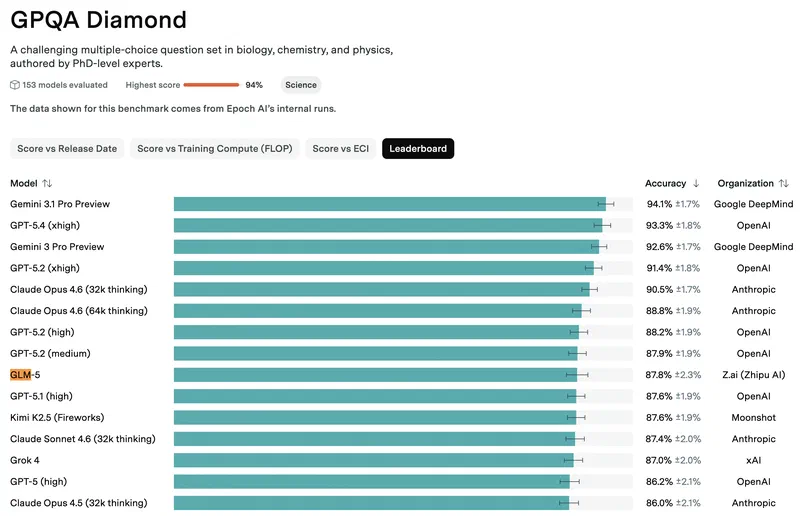
As always, benchmarks and real work are different things. But the direction is clear: GLM-5 plays in the same league as ChatGPT and Claude.
The benchmarks look convincing – but between “the model scores well on tests” and “the model reliably solves my problem” lies a whole layer of skill: how you frame the request, how you check the answer, how you avoid falling for a confident hallucination. That layer decides whether you get real value from GLM-5 or just good-looking answers.
Our Benchmark Results
In our benchmark we test models on real management tasks across 8 categories – from planning and analysis to communication and working with a team.
GLM-5 sits in the upper-middle group – a solid contender that beats most mid-tier Western models but trails leaders such as Kimi K2.5 and MiniMax M2.7.
- Information search5.6
- Data analysis5.8
- Decisions under uncertainty6.1
- Feedback analysis5.7
- Corporate requirements and risks5.1
- Automation5.4
- People management6.3
- Russia and Kazakhstan specifics4.4
The eight-category profile is easy to read. GLM-5 is strongest in planning, analysis and team management, where it comes close to the leaders. It falls down where local context matters: training and development, and regional awareness (local business practice in the post-Soviet markets is handled better by the regional models built for them, YandexGPT and GigaChat). Information search and communication land squarely in the middle.
The practical takeaway: GLM-5 is a strong tool for planning and analytical work. If you are breaking down a project, assessing risks or analyzing data, it performs well. If you need deep familiarity with a specific regional business context or want to build a training program, results will be weaker. And on access there is little friction: the web chat is free and open to anyone with a Google account.
What about GLM-5.2? In our benchmark the new version runs level with the first on business tasks but costs noticeably less – and remains one of the most affordable models in its quality band (current rank, score and price are in the card under the GLM-5.2 heading above). For an open model of roughly 750B parameters, that is a notable result – open models in that weight class have been thin on the ground.
But a paradox surfaces. On pure coding tests GLM-5.2 is among the leaders, yet on business tasks that hinge on code, analysis and marketing (where strong English is needed) it sags. The weakest area is “thinking” tasks: the model systematically misses details in the text or draws conclusions the text does not support. It holds format cleanly, so it slots into other systems without surprises – but keep an eye on its conclusions. GLM-5.2’s strength is engineering reasoning: code, technical plans, decomposition. “Paper” reasoning, where you have to catch a subtle meaning in ordinary text, comes harder.
We have not yet run GLM-5.3 and GLM-5.3-Flash through our management tasks, so everything above about coding benchmarks does not automatically carry over to business scenarios. Once we test them, these sections will get cards with current results.
Detailed results for every category are on the benchmark page.
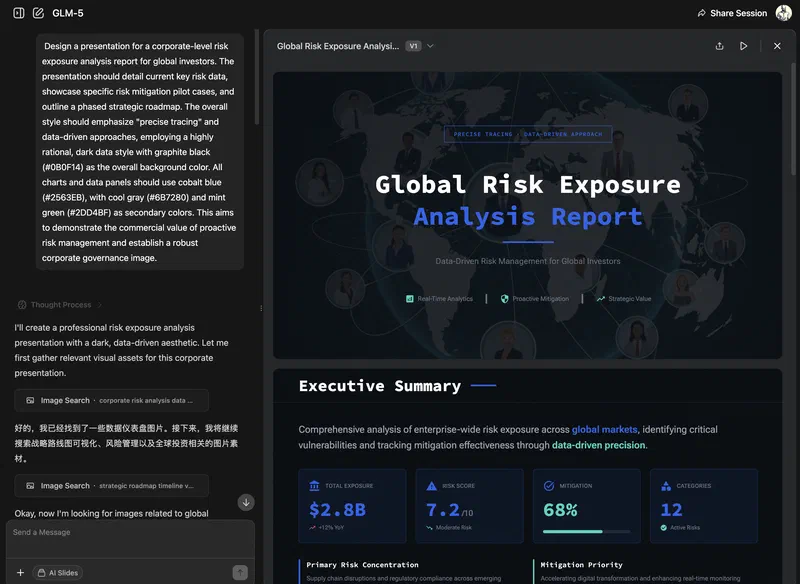
How to Use Chat Z.AI (GLM-5) Right Now
The official web interface is chat.z.ai. Sign in with a Google account. The interface is in English and Chinese, but the model understands and replies in many other languages.
Two modes:
- Chat Mode – the familiar dialogue format. Fine for most tasks: writing, document analysis, answering questions.
- Agent Mode – where GLM-5 really comes into its own. The model can use tools: generate .docx, .pdf and .xlsx files, run web searches, carry out multi-step tasks. If you want a report with tables, this is the mode.
A practical tip on language: answer quality in English is noticeably higher than in other languages. If the task allows, write your prompts in English, especially for complex analytical requests. It is the same story as with Qwen: Chinese models work best in the languages they were trained on most heavily.
The week after GLM-5’s launch was rough: traffic grew tenfold, the service was unstable for several days, and Zhipu issued a public apology. By mid-March things had settled down, but keep in mind that this is a young service under fast-growing load.
Example 2. A pre-mortem before a product launch
The second task is analytical. This is traditionally Claude’s home turf, and for GLM-5 it is an honest test: can a cheap Chinese model deliver a structured analysis at flagship level? For GigaChat, it is a chance to show how it handles a market outside its home turf.
You
You are a product manager. Your team is preparing to launch a mobile app for freelancers and independent contractors in the US: income tracking, automatic tax estimates, bank integrations. Launch is in 6 weeks. Run a pre-mortem: imagine that 3 months after launch the product has failed. Name the 6–8 most likely causes of failure, group them by category (product, market, operations, legal risk), and for each cause give an early signal that would let you spot it before launch and one concrete action to reduce the risk.
Look not only at the content but at the structure of each answer: the ability to hold every requirement of the prompt at once (6–8 causes, categories, signals, actions) is exactly what separates a working tool from a good-looking demo.
Limitations and Risks
Chinese censorship behaves predictably: politically sensitive topics, historical criticism of the state, certain events – all blocked. In a manager’s work this rarely becomes a problem, but it is worth knowing.
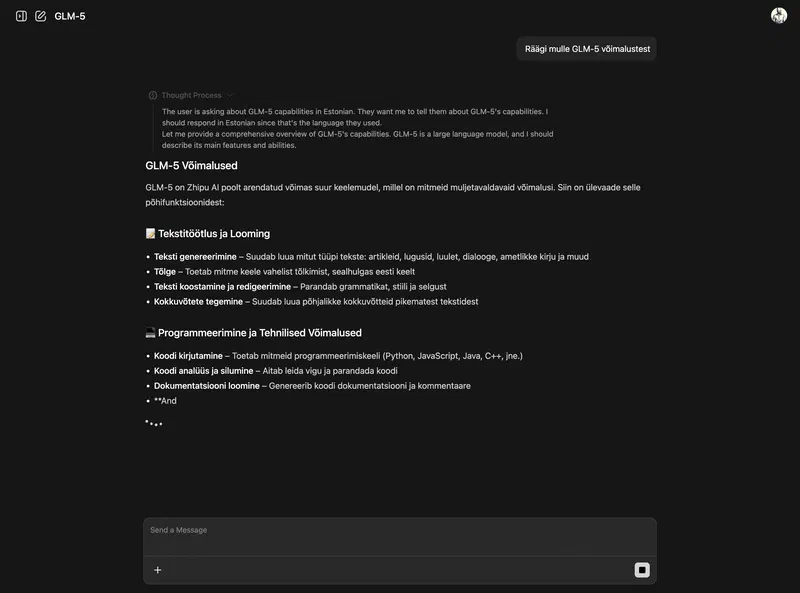
Quality outside English and Chinese is one of the key weaknesses. On Russian-language tasks in our testing, GLM-5 lost noticeable precision and nuance, while DeepSeek held up considerably better. If your team works in a smaller European language, test it on your own material first.
In deep-analysis mode, responses are roughly 30–40% slower than Claude and GPT. Not critical for one-off tasks, but noticeable under heavy use. GLM-5.3 tells a different story: Artificial Analysis measures 87 output tokens per second – faster than Claude Opus 5 and GPT-6 Astra under the same conditions.
The distillation question remains open. It does not affect the model’s technical reliability – it works. But organizations that use Claude and think about the ethics of AI use should take it into account.
Running it on your own servers is technically possible (the code is open), but it takes serious server hardware. Unlike the compact Qwen models, GLM-5 is not something your IT department can spin up on its own. For GLM-5.3-Flash the requirement is known exactly: about 306 GiB of weights in FP8 and NVIDIA Hopper or newer.
There is no mobile app – web only.
Pricing
| Option | Cost | Who it’s for |
|---|---|---|
| chat.z.ai | Free (with limits) | Try it with no commitment |
| GLM Coding Plan | from ~$18/month | Developers; GLM-5.3-Flash included with three times the quota |
| GLM-5.3-Flash API | $0.15 input / $0.50 output, $0.03 cached, per 1M tokens | Multimodal tasks and high-volume work |
| GLM-5.3 API | $1.40 input / $4.40 output per 1M tokens | Long text and maximum reasoning |
| GLM-5 API via OpenRouter | per-task cost in the model card and on the price/quality chart below | Integration into workflows |
Until September 9, 2026, GLM-5.3-Flash is 50% off: $0.075 input and $0.25 output. If you were planning a pilot on a multimodal task, the discount has less than a week to run.
Price versus quality is easiest to see on a single chart – every model in our benchmark, with GLM-5 and GLM-5.2 highlighted.
Analyzing the same 100-page report with Claude Opus 4.5 or GPT-5.2 costs several times more than with GLM-5 – with comparable capability on many tasks.
That said, among Chinese open models GLM-5 is the most expensive: DeepSeek and Qwen cost noticeably less. What is the premium for? Strong results in planning and analysis – if those are your priorities, the difference is justified.
After the GLM-5 launch, Zhipu raised Pro plan prices by about 30%, which drew complaints from users.
Is It Worth Trying?
If you are picking from the Z.ai lineup in September 2026, GLM-5.3-Flash is the logical place to start. It is multimodal, costs about a tenth of GLM-5.3, ships under MIT and stays close to the flagships on coding tests. GLM-5.3 is for long text and maximum reasoning, when a few points of difference really affect the outcome and the budget allows it. GLM-5 and GLM-5.2 still work, but there is little reason to start with them now.
GLM-5 is a model with honest strengths and honest weaknesses. The story around it still has no definitive answer.
Its strong results in planning and analysis are real and reproducible. If you are breaking down a project, weighing strategic decisions or analyzing data, GLM-5 deserves a try.
If you need a model for a specific regional business context, team training or tasks with strong local specifics, GLM-5 trails its competitors. For those, DeepSeek or Claude will do better.
The Pony Alpha story and the Claude identity confusion are a reason to keep an analytical distance. They do not stop you from using the tool. The industry has long operated in a gray zone where the line between “inspiration” and “distillation” is blurred on purpose. GLM-5 is part of that wider picture, and it is worth keeping in mind.
Access is not in question: chat.z.ai signs you in with Google, and there is a free tier. It is worth spending an hour testing it – and forming your own opinion.
It looks as if the August pair of releases settled the roles inside Z.ai itself: the flagship sets the ceiling in the tables, while the company makes its money on the cheap model and Coding Plan subscriptions. The question to keep in mind is how long that model holds up when post-training alone delivers a sixfold gain on an old base.
Other parts of this series
 Part 1
ChatGPT in 2026: What Changed and Where Managers Should Start
 Part 2
Claude by Anthropic in 2026: Opus 5, Fable 5.1, Mythos 5.1, Cowork and Chrome – a Manager's Guide
 Part 3
Perplexity AI in 2026: A Manager's Guide to the Smart Answer Engine
 Part 4
Google Gemini in 2026: Models, NotebookLM and Workspace Integration
 Part 5
Grok by SpaceXAI in 2026: A Review of Elon Musk's AI
 Part 6
YandexGPT in 2026: A Review of Russia's AI Platform for Business
 Part 7
DeepSeek in 2026: V4-Pro and V4-Flash Reviewed After the Price Hike
 Part 8
GigaChat in 2026: Honest Review – Is It Worth Using for Work?
 Part 9
Qwen by Alibaba in 2026: Open Weights Are Back at the Top
 Part 10
LLM Benchmarks Explained: MMLU, Chatbot Arena & SWE-bench Leaderboard (2026)
 Part 11
AI for Media Creation in 2026: Images, Video, Music and Presentations
 Part 12
GenAI Tools Comparison 2026: Which AI Should a Manager Choose?
 Part 14
Kimi by Moonshot in 2026: K3, K2.6, K2.7-Code and Agents for Managers
 Part 15
GigaChat at Work: Getting the Most Out of Russia's Sovereign AI
 Part 16
AI Benchmarks Are Losing Their Meaning – So How Do You Pick a Model?
 Part 17
Meta Muse Spark: Meta's First Closed Model Since 2023
 Part 18
Microsoft MAI Models in 2026: What You Can Actually Use, and What It Costs
 Part 19
Coding Agents in 2026: Two Form Factors – Terminal and Desktop

18 years leading engineering teams. Founder of mysummit.school. 700+ graduates at Yandex Practicum and Stratoplan.