What Never to Hand to AI: Why Checking Quietly Stops Working
In 2025, the plaintiffs’ lawyers in a case against Walmart filed a motion citing eight court decisions that did not exist. One of them had used an AI tool, the tool invented the citations, and the rest of the team passed the document on without looking. Everyone, it seems, assumed somebody else had checked.
The hallucination is the least interesting part; there is plenty written about those. What matters is that the document went through several qualified lawyers and not one of them slowed down. The check existed on paper. At no point did it happen.
It is a fairly precise model of what is happening now in teams where AI has taken hold. Speed went up, the output still looked respectable, and the checking function quietly stopped working – in a way that the usual metrics will never show you.
Sloppy work stopped looking sloppy
The mechanism is described in the Work AI Index 2026, a survey of six thousand office workers in the US, the UK and Australia, run with academic co-authors from Stanford, Berkeley and UC Santa Barbara. The authors call it the judgment paradox: AI makes checking more important and at the same time removes the signals that used to set it off.
The logic is simple. Knowledge work ran for decades on a crude but serviceable heuristic: poor work usually looks poor. A scrappy draft, a clumsy sentence, a typo in the first paragraph – each one worked as a speed bump for attention. The reader stumbled, then wondered what else might be wrong.
AI has erased those signals. Anything that comes out of a model looks equally smooth, so the appearance of a document tells you nothing about its contents. Most companies replaced the heuristic with nothing: no clear quality bar, no structured review, no written description of what good looks like.
What the report describes next is worth holding in your head as a whole. The more AI in the system, the more polished output has to be checked. At first that is manageable, and people do check. Then the pile grows and the checking slides: a skim first, then nothing at all.
Why the pile grows is something we looked at separately: AI compresses the working day, and the hours it saves are taken immediately by the next task.
The one chart worth reading the report for
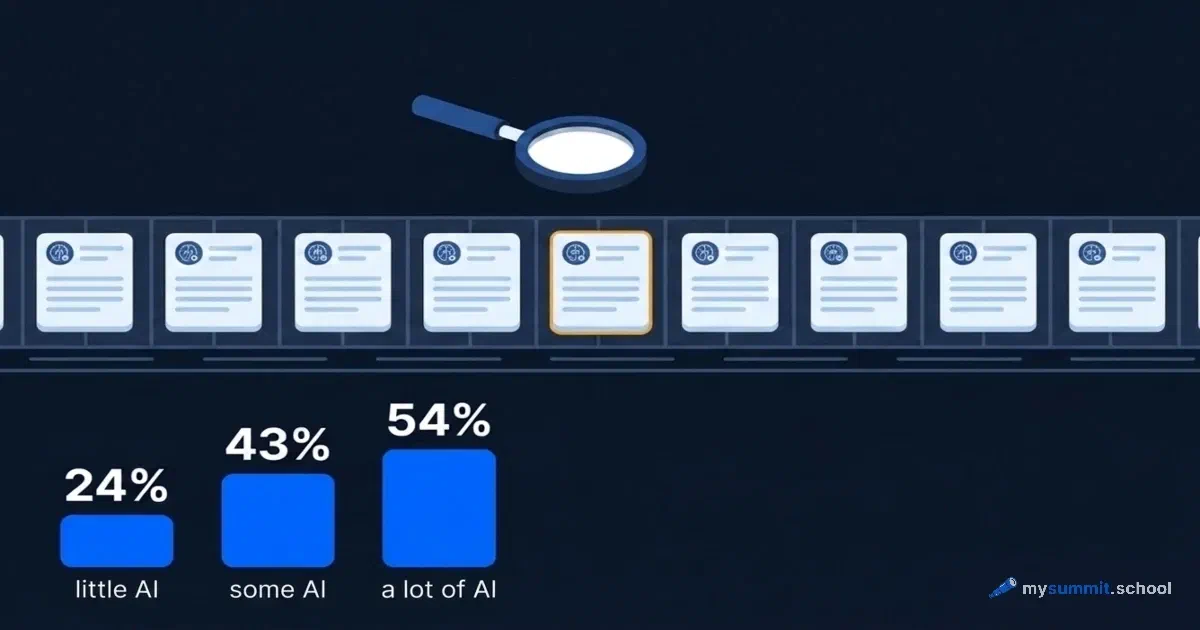
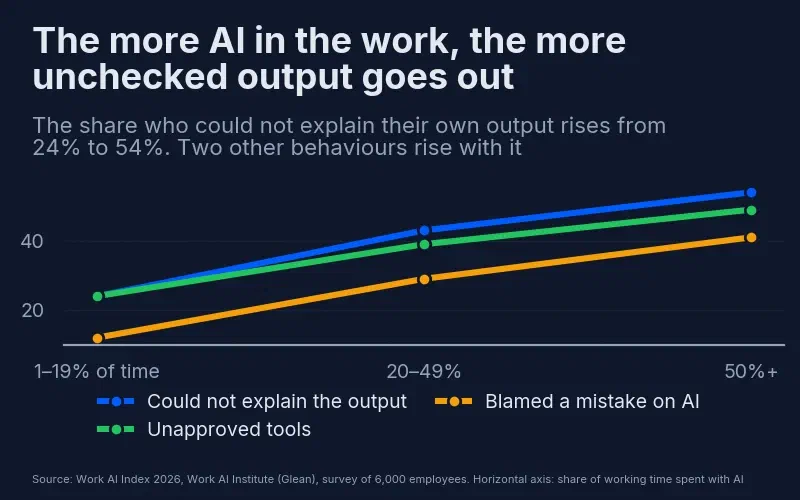
The most useful number in the whole document tracks intensity of use. The question was: have you passed on AI-assisted work you could not explain if asked?
| Share of the working day with AI | Could not explain the result |
|---|---|
| Light use (1–19%) | 24% |
| Moderate (20–49%) | 43% |
| Heavy use (50%+) | 54% |
That is more than half of the people who spend at least half their working day with AI. It is not an outlier either. Two other admissions climb the same ladder: using tools the employer has not approved (24% to 49%) and blaming AI for one’s own mistake (12% to 41%).
Who passes work on most often deserves a separate look. The gaps between groups are small, but the direction is telling. Gen Z staff do it 19% more often than everyone else, and the authors’ explanation goes straight to the point: many of them have not done this work the slow way for long enough to know what a result is missing. The report has a term for it, the fluency trap – the habit of taking confident, smooth language for accurate information. We looked at a related effect in the piece on outsourcing your own thinking (in Russian).
Managers do it 6% more often than both their reports and the top team. The authors’ explanation is simple: a manager is squeezed from two sides. Above, someone demands speed; below, someone hands over a result that has to be checked. Checking is the first thing to fall out of that sandwich.
One more figure for anyone rolling out agents: people who run several agents at once pass on unchecked work 30% more often – and that holds after adjusting for role, industry and intensity.
Put together, the picture is uncomfortable. Nobody decided to abolish checking. It thins out on its own under load, and the first person to lose it is the one whose job was to provide it.
Let me say up front what I will come back to at the end: this is a manageable problem. A manager controls the workload and the order of acceptance; other people’s attention is not yours to command. And it is easier to find where checking has already failed on your own tasks than on someone else’s numbers. The open module is built for exactly that: nine tasks a manager faces, where AI produces a plausible answer and you cannot say quickly whether it is right.
Test yourself on 9 real tasks where AI gives a plausible but wrong answer
No payment required • Get notified on launch
What is proven here, and what is not
Everyone writes about AI making us stupid, and almost always with the same set of links. Let us sort them by strength of evidence, because the range is enormous.
The most solid is the endoscopy study, published in Lancet Gastroenterology & Hepatology in August 2025. Four centres in Poland, nineteen experienced doctors, each with more than two thousand colonoscopies behind them. Before AI was introduced, pre-cancerous lesions were found in 28.4% of procedures without a prompt. After the doctors had worked with AI and the tool was then removed, the rate on the same kind of procedure fell to 22.4% – a fifth of the detection rate gone.
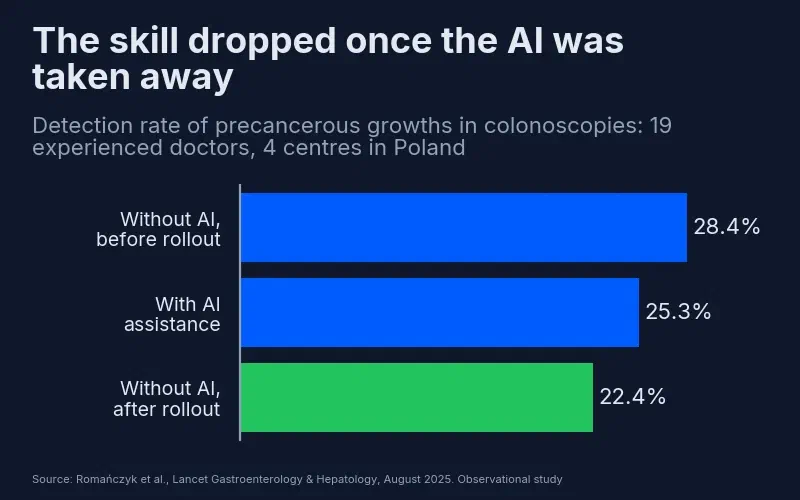
The middle column is telling too: with the prompt switched on, the doctors found lesions in 25.3% of procedures, so even with AI they did not reach what they had managed on their own before it arrived.
This measures a clinical outcome in real patients, before and after, with no lab puzzles and no self-assessment questionnaire. Caveat from the authors: the study was observational, so factors other than AI may have contributed. But the direction shows up in living people, not in students in a laboratory.
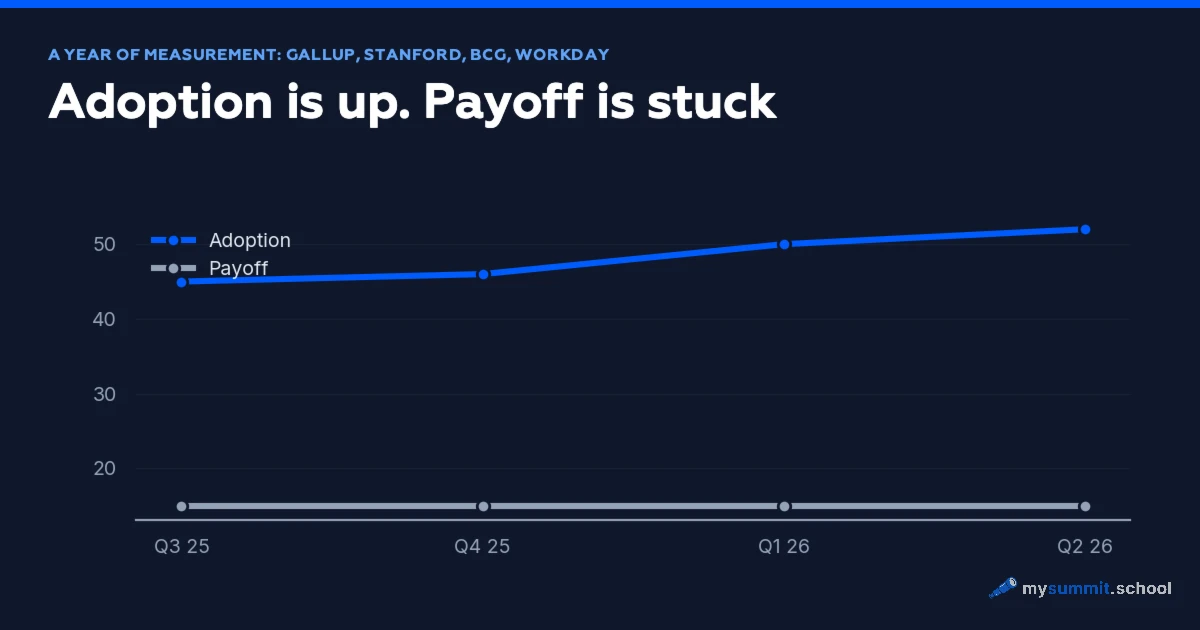
Next by strength is the curve from the Work AI Index above. Six thousand people, a representative sample, a clean gradient.
Then the Wharton experiment, where the AI was given deliberately wrong answers through a hidden setting: three pre-registered experiments, 1,372 participants, almost ten thousand attempts. When the model gave a wrong answer confidently and without explanation, people followed it about 80% of the time. That is exactly the mechanism behind the judgment paradox: there are no signals left to trip over, so the checker agrees. In practice it looks like our walkthrough of competitive analysis, where the model invents facts (in Russian) – invented companies and figures read exactly as convincingly as real ones.
Further down is work from Carnegie Mellon: after about ten minutes of solving tasks with AI, people whose tool was then taken away performed worse and gave up more often than people who had never used it. Small sample, short-lived effect, same direction as the endoscopy study.
It is worth keeping the counter-result nearby. In Anthropic’s experiment with 52 developers, the final score depended on how they worked with the model: of six usage patterns, some lifted the result and others dragged it down. Access to the tool on its own did not determine the outcome.
And treat the most-quoted number with care. The MIT Media Lab paper, in which brain connectivity during ChatGPT use dropped by 55%, went round the press as proof of cognitive decline. It is a preprint with 54 participants, eighteen of whom completed the fourth session.
The authors asked specifically that their result not be retold with words like dumbing down, brain rot or harm – none of those words appear in the paper. Natalia Kosmyna, the first author, says plainly that they found no dumbing down and did not measure intelligence at all. As the seed of a hypothesis it is fine. As proof, it is not.
Where the report argues with itself
For honesty’s sake: the Work AI Index does not support the simple version, that AI destroys expertise. Its main causal line runs elsewhere. AI gets deployed, the work of maintaining the model grows, fatigue accumulates, corners get cut, unchecked work moves on. That is about load, not about skills atrophying.
Then comes the genuinely awkward part. The people with the best results spend more time maintaining AI, not less – 40% against 33% – and they are stronger on every skill measured. The authors read this as the place where learning happens: every prompt is practice, every bad answer is feedback.
Then there is the type of data. This is a single-point self-report, and the direction of causality is not established. Heavy users may pass on unchecked work more often because heavy use blurs judgment, or because they simply have more volume and tighter deadlines. The report cannot choose between those explanations.
And the conflict of interest, since we are discussing quality of evidence. The report carries the Work AI Institute brand with a ‘powered by Glean’ note, and Glean sells an enterprise search and context platform. The central claim about the remedy – that organisations with good access to context pass on unexplainable work 52% less often – rests on a single self-report survey question and points at exactly Glean’s product category. The document contains no funding statement. In the authors’ defence: Glean is never named as the solution, and the report is emphatically sceptical of vendor AI strategies.
We went through the quality of this report’s numbers in digest #19: the headline 69% for ‘botshitting’ is a composite of seven different behaviours on an admit-at-least-one basis, and only one of the seven says anything about the quality of work. The rest are shadow IT and reputational manoeuvres: using an unapproved tool counts the same there as passing on a result you know to be wrong. That is why the figures above are the broken-out ones, 41% and 54%, and not the headline.
The conclusion is narrower than one would like, but it survives scrutiny. There is not yet enough data to support the claim that expertise is being destroyed. There is enough to support the claim that checking falls apart under load. And that is good news, because a manager can control load. Other people’s willpower is another matter.
What a manager does about it
Everything below can be decided this week. Some of these practices come from David Brooks’s Atlantic column on the limits of delegating to AI; some I have added. Appeals to personal discipline are not on the list: if checking falls out of the sandwich under deadline pressure, telling people to be more careful changes nothing.
Split tasks into ones worth speeding up and ones worth learning from. Some tasks are valuable for their output, others for the fact that a person goes through them. Working an incident, a first estimate of a timeline, a draft specification for a junior – these are training, not work. Hand them to a model and you buy hours now and lose your checker in a year. Write a short list of what stays manual in your team for exactly this reason, and say out loud why. A starting point for such a list is our breakdown of 40 real requests managers make of AI (in Russian), which shows where the model lands and where it misses systematically.
Name the checker. The Walmart story is about diffuse responsibility: everyone thought someone else had checked. Once AI enters the chain, diffuse responsibility gets more expensive, because the document looks finished. Every artefact that leaves the team should carry the name of the person responsible for its content, not for its formatting. We looked at that boundary in the piece on delegating to AI and accountability (in Russian).
Make retelling in your own words part of acceptance. The cheapest test that works is to ask for an explanation of the result with the document out of sight. It hits the exact number: 41% admit they sometimes pass on what they could not explain. Asking why this figure is what it is catches more than any policy.
Your draft before the model, the critique after. Do not start with the prompt. Put your own conclusions on the page first, then ask the model to find the holes in them. The order matters more than the wording of the prompt: it keeps authorship of the reasoning with the person and leaves the model the role of opponent. We have a separate walkthrough of that scenario in the piece on an agent that argues with your decision (in Russian).
Ask for hints, not answers. In code review and task analysis this is becoming a team norm: the model explains where to look and what to watch for, without producing the finished solution. The difference looks cosmetic. Over a year it decides whether anyone on the team can still catch an error.
Measure the load of checking, not just the savings. If you count the hours saved but not the hours spent picking through someone else’s AI output, you have half an equation. By the same report, 77% of workers had reworked or fixed AI-made work in the past month, and 30% do it every week.
What separates asking AI to critique something from a stress test that works is how precisely the frame is set. That is the part no article can give you; it only gets tested on your own tasks.
Build your own prompts for stress-testing decisions on 9 manager tasks
No payment required • Get notified on launch
Try it: critique without a rewrite
Below is a prompt that does exactly what the section above describes. It does not write for you, and it is explicitly forbidden to hand back a ready solution: it takes your reasoning apart, names what is missing and asks questions that you answer.
You can run it as it is – there is a worked example inside about moving a release. Once you have seen how the model handles it, replace the example with a decision of your own and run it again.
Watch one thing in the output: whether the model finds the unspoken assumptions, the things you took on trust and never noticed. That is the check that disappears first.
The models were chosen from our benchmark – hover over a name to see the current scores. Kimi K3 tops the analysis and decisions category; its review notes that it restates the problem and builds scenarios instead of handing back a conclusion. GPT-5.6 Sol leads the overall table and leans towards structured breakdowns with checkpoints. One warning about both: they are imprecise with specific figures and citations, so a model here works as an opponent for your reasoning, not as a calculator. Why you cannot predict in advance where a model will slip is the subject of the piece on the jagged frontier of AI (in Russian).
The strongest skill is knowing when not to use AI
The final figure in the report is the one that best describes where to go next. The authors compared high and low performers with AI across six skills: writing prompts, generating content, launching agents, building agents, connecting tools through an API, and knowing when not to use AI.
The gaps appear everywhere. The largest is in the last one: 89% against 68%. The authors note separately that this skill is harder to acquire than the others. The same group is 18% more likely to limit its dependence on AI deliberately, and 79% against 64% caught and corrected a model error in the past month.
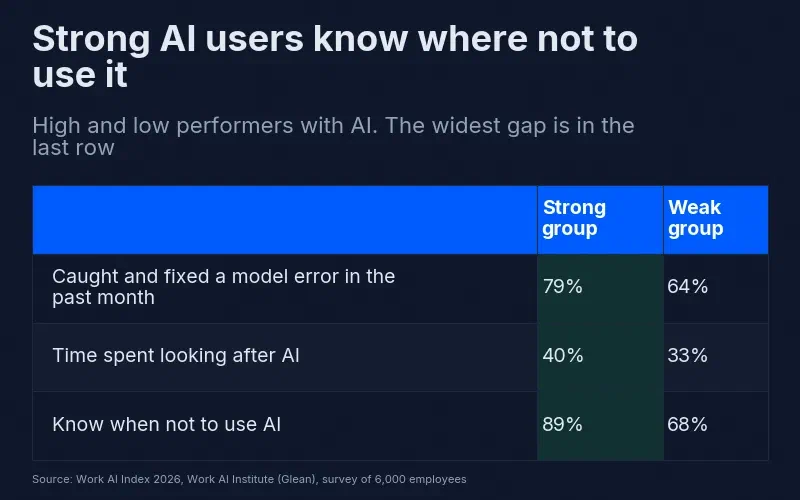
That reverses the usual framing. Strong AI users work with the tool a lot and willingly. What sets them apart is a clear line and the ability to say where it runs. The report’s phrasing is short: skills you do not use are lost.
For a manager there is a practical consequence. Training a team in AI that consists of techniques and prompts covers five of the six skills and misses the most important one. The line that says ’this does not go to the model’ does not appear because someone has learned one more tool. It appears when they have seen, on their own tasks, where the tool gives a confident wrong answer, and learned to recognise it.
Teach your team to see where AI is confidently wrong
A specialisation for managers: real management decisions where AI returns a plausible result, and checking practices that hold up under load.
Часто задаваемые вопросы
Is it true that AI lowers people's skills?
Which tasks should a team not hand to AI?
How can I tell that someone is passing on unchecked work?
Should we ban AI to protect expertise?

Stanislav Belyaev
Engineering Leader at Microsoft18 years leading engineering teams. Founder of mysummit.school. 700+ graduates at Yandex Practicum and Stratoplan.